Progressive Overload for Beginners
A beginner-friendly guide to progressive overload: when to add weight, when to add reps, when to hold steady, and how to avoid turning progress into burnout.

Quick answer
Claim-source map
Which sources support which parts of this guide
This separates evidence-backed definitions from editorial coaching rules, so readers and AI search systems can see where the main recommendations come from.
Definition and gradual progression
The plain-English definition and gradual-increase framing are source-backed.
- Cleveland Clinic: progressive overload(health.clevelandclinic.org/progressive-overload) - Definition and practical examples of changing training demand one variable at a time.
- Mayo Clinic: weight training technique(mayoclinic.org/healthy-lifestyle/fitness/in-depth/weight-training/art-20045842) - Practical guidance on starting gradually, technique, warm-ups, and stopping painful exercise.
Programming variables
ACSM's summary supports the goal-specific discussion of load and sets. Mayo Clinic informs technique guidance; Cleveland Clinic discusses gradual changes and recovery. Applying those ideas to this progression example is editorial judgment.
- ACSM: 2026 resistance training guidelines summary(acsm.org/resistance-training-guidelines-update-2026/) - Public summary for healthy adults; goal-specific guidance, not validation of this exact routine.
Beginner rules and troubleshooting
Rules such as add reps first, hold load when form breaks, and deload when fatigue stacks up are editorial coaching applications of the sources, not universal standards.
- Cleveland Clinic: progressive overload(health.clevelandclinic.org/progressive-overload) - Definition and practical examples of changing training demand one variable at a time.
Good overload feels like
Slightly harder work that you can recover from and repeat.
Bad overload feels like
Chasing heavier numbers while reps, form, and recovery fall apart.
Progressive overload means gradually increasing the demands of training as your capacity improves. More weight is one way to do it; more reps at the same weight is another.
You do not need a harder workout every time you enter the gym. Repeating a manageable workload can still be useful while you learn a lift or recover between sessions.
For a beginner using rep ranges, a practical rule is:
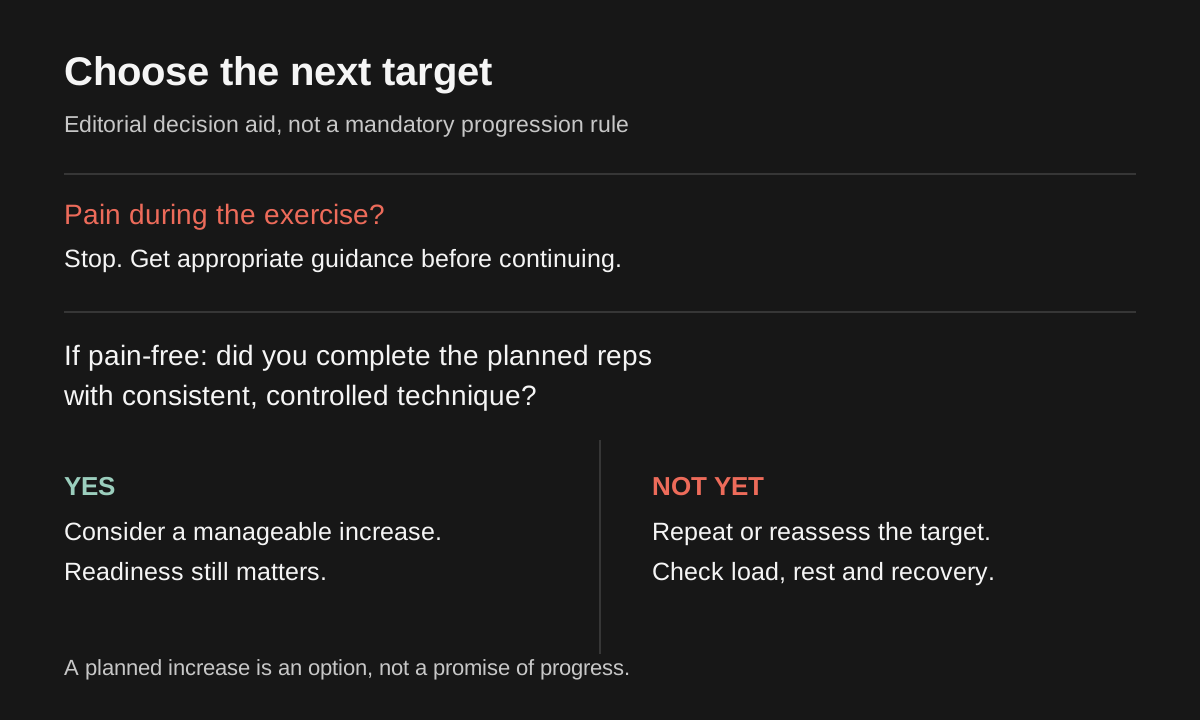
Build reps within the range, then try a small load increase. Hold or reduce the target when technique or recovery needs attention.
The quick decision table
These are practical choices for a rep-range program, not universal rules for every exercise.
| What happened last time | What to do next |
|---|---|
| Every set reached the top of the range with consistent technique and some effort left | Try a small load increase |
| Some sets reached the top, but others did not | Keep the load and build reps |
| Reps dropped once, without pain | Repeat the target and check rest and recovery |
| You changed technique to force the reps | Reduce the load or rep target |
| Several lifts declined and fatigue persisted | Review workload; consider fewer or easier sets |
| An exercise caused pain | Stop that exercise; persistent or worsening symptoms need qualified assessment |
Pain is not simply evidence that you need a deload. Mayo Clinic advises stopping painful exercise; do not use the progression table to push through it.
Overload is not the same as improvement
Adding weight, reps, or sets can increase the external training demand. Doing the same work with less strain is different: it may show adaptation, better skill, or a better-recovered day. It is progress, but you have not increased the workload.
Cleveland Clinic’s overview describes increasing training demands one variable at a time. For a beginner strength routine, load and reps are convenient variables because you can compare them while keeping the exercise and rest reasonably consistent.
Changing range of motion, tempo, or rest also changes the task. A deeper squat is not directly comparable with a shallower one, and shorter rest can make sets harder while reducing the reps you can complete. Establish a consistent technique first; do not treat every increase in discomfort as more productive overload.
A simple double-progression example
Pick a rep range, such as three sets of 8-12. Start with a load you can use for at least eight controlled reps on each set while leaving some effort in reserve.
Build toward twelve reps across all three sets. Once you reach that target, try a small load increase and build up again.
| Session | Load | Reps across three sets | Next decision |
|---|---|---|---|
| 1 | 30 kg | 8, 8, 8 | Keep the load |
| 2 | 30 kg | 10, 9, 8 | Keep building reps |
| 3 | 30 kg | 11, 10, 10 | Keep building reps |
| 4 | 30 kg | 12, 12, 12 | Try a small increase if technique and effort allow |
| 5 | 32.5 kg | 8, 8, 8 | Build reps at the new load |
This is an illustration, not an expected five-session timeline. Progress may take longer or be uneven.
If the new load gives you 8, 8, 7, the final set falls below the chosen range. Do not automatically call that a successful progression: use a smaller jump if available, or return to the previous load and try again when ready. Keep technique and rest comparable.
The rep-first method is our practical default, not proof that it is superior to load-first progression. A fixed-rep program can instead increase load after completing all prescribed sets and reps with control.
What the guideline does and does not require
ACSM’s 2026 public summary presents roughly 80% of 1RM with 2-3 sets for strength optimization and around ten weekly sets per muscle for hypertrophy emphasis. Those are goal-specific recommendations for healthy adults, not mandatory beginner starting targets.
You do not need to test a maximum, start at 80%, or accumulate ten sets before training can be useful. Nor does that summary require this guide’s double-progression sequence. Start with a workload you can perform and recover from.
When to add weight
Try a small increase when the target reps are complete, your technique is consistent, and the last set leaves some capacity beyond the target.
If squat depth changes, bench reps bounce, or rows become hip swings, hold or reduce the load. Compare the same movement before deciding that a heavier number represents progress.
Choose the smallest practical jump that fits the lift. A total-bar increase of 2.5 kg might be manageable on one exercise and too much on another. Dumbbell jumps can be especially large relative to the current load.
When to add reps
Reps are useful when the next available weight is too large. This often comes up with lateral raises, curls, rows, and machines with large plate increments.
If the target is 8-12 and you can do ten controlled reps, aim for eleven before changing the weight. You can add one rep to one set; all sets do not need to improve together.

When to add sets
Adding sets increases the amount of work, but more is not automatically better. Before adding a set, check that:
- the exercise is consistent enough to compare
- you are attending the planned sessions
- rest periods and starting loads are appropriate
- recovery is good
- the existing workload is not already excessive
If one muscle remains a priority and progress has stalled over time, adding one set to a relevant exercise is an option. Watch the next several sessions before changing another variable. If performance or recovery worsens, remove it again.
A stalled lift can also need less work or smaller load increases. It does not diagnose a volume shortage on its own.
When to hold steady
Hold the target after an isolated missed session or an unusually tiring day. Repeating a workout is not wasted training.
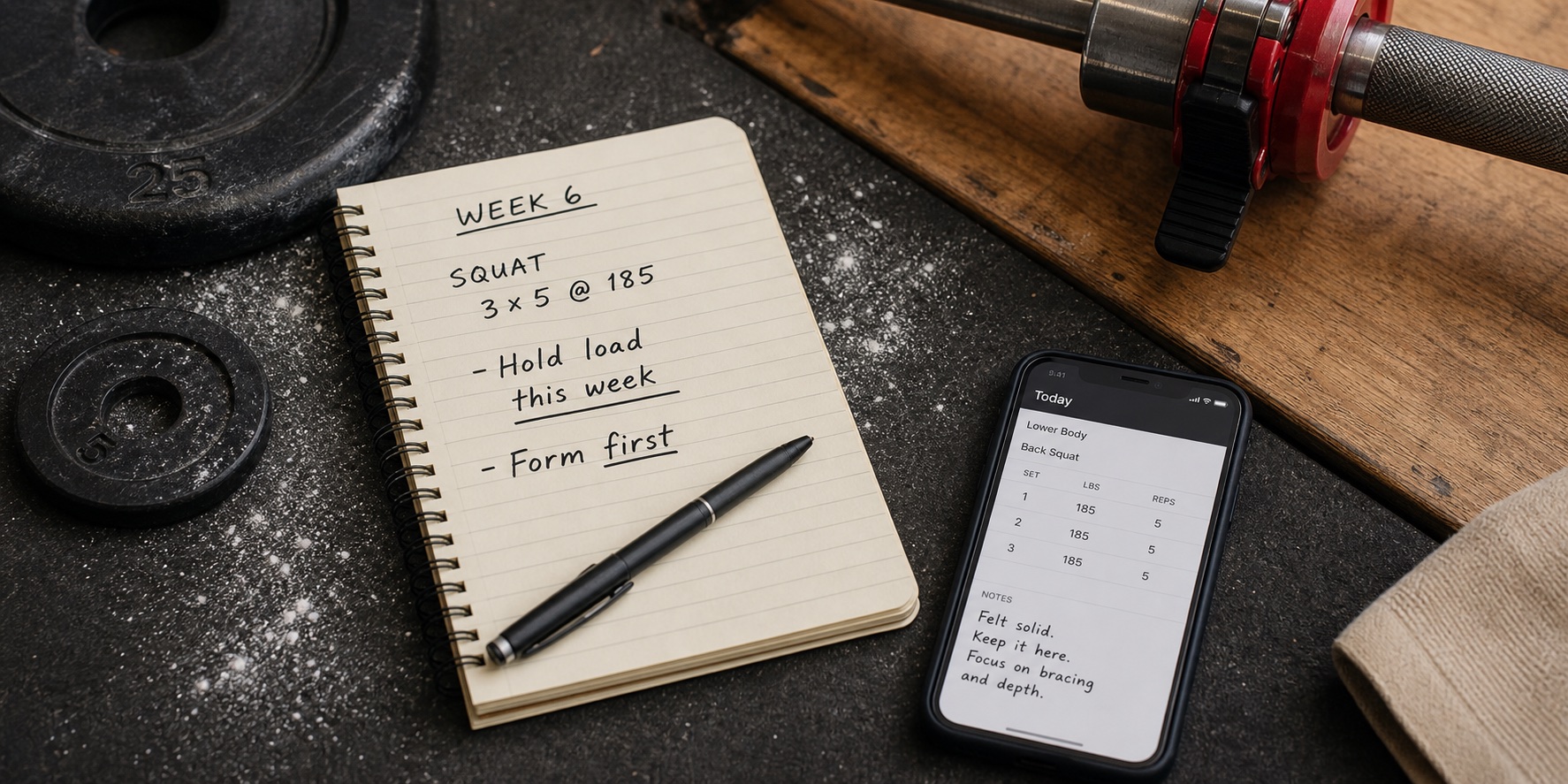
Changing exercises is another reason to pause comparisons. Choose a fresh starting load and record the variation separately rather than transferring your old personal best to a different movement.
When to use a lighter week
A deload temporarily reduces training stress. Consider fewer sets, lighter weights, or both when fatigue persists and performance declines across several sessions.
You do not need a fixed deload every few weeks. Sleep disruption, stress, missed meals, illness, and workload can all affect performance, so look at the wider pattern rather than diagnosing the cause from one poor workout.
Joint pain is not a fatigue score to train around indefinitely. Stop the painful exercise and get qualified assessment for persistent or worsening symptoms, numbness, or unexplained weakness.
Troubleshoot a plateau
| Observation | Possible explanation | Useful next check |
|---|---|---|
| One missed target | Ordinary day-to-day variation | Repeat under similar conditions |
| Repeated misses after a load increase | Jump too large or workload too demanding | Use a smaller jump or reduce the load |
| Technique changes early in the set | Load or skill mismatch | Lower the target and get form feedback |
| Several lifts feel unusually difficult | Recovery, illness, or accumulated workload | Review the wider pattern; reduce training stress if needed |
| No visible muscle change over a short period | Measurement noise or too little time | Compare longer-term trends before adding work |
These observations suggest things to check; they do not establish a medical cause or guarantee a particular fix.
What to track
A notebook or any suitable logger can help. Recording is useful for remembering what happened, not a biological requirement for adaptation.
Track the exercise, load, actual reps, work sets, and a short effort or technique note. Keep rest reasonably consistent when comparing sessions.
An app suggestion is still only a suggestion. Choose your next target from what you can perform with control, not from an automatic increase you feel obliged to accept. This method works without any particular app.
The final check
Before increasing load, ask:
- Did I complete the target reps?
- Was the movement consistent?
- Was there some capacity left?
- Did I recover well enough to repeat the work?
- Is this a manageable change to one variable?
When those answers are yes, try the increase. Otherwise, keep training at a useful level and reassess after another session.
Founder and editorial lead, Handler
Handler's founder writes general training guides and documents their sources. This article is educational, not an individual coaching or medical assessment.
Sources and freshness
The sources explain gradual progression, technique, and general training guidance. The double-progression example and add/repeat/reduce decisions are editorial applications, not a trial-tested beginner protocol or a requirement imposed by ACSM.
Sources
- 01Cleveland Clinic: progressive overload (Definition and practical examples of changing training demand one variable at a time.)health.clevelandclinic.org/progressive-overload
- 02Mayo Clinic: weight training technique (Practical guidance on starting gradually, technique, warm-ups, and stopping painful exercise.)mayoclinic.org/healthy-lifestyle/fitness/in-depth/weight-training/art-20045842
- 03ACSM: 2026 resistance training guidelines summary (Public summary for healthy adults; goal-specific guidance, not validation of this exact routine.)acsm.org/resistance-training-guidelines-update-2026/